
The Writing Game
Build agency by helping students get out of their own heads.

Most of us need to teach writing. I came across many pain points with this over the years. Too many to mention here.
One of the main problems was how students got themselves so inside their heads that they couldn’t get going. Even if they were given some awesome topic to write about without restrictions, many of them would just sit there looking around the room.
They would get an idea, then dismiss it as not good enough, blocking their own creativity by not getting started.
Those who did get started would then sit for ten minutes trying to remember how to spell a word before writing it down. Many would then give up and write something less interesting, so long as they could spell it correctly.
Instead of a vast forest, it would be a big one.
Instead of a colossal tree, it would be tall.
And so on.
Then, you have erasers. I can’t stand these things. I even banned them.
So much time was wasted by students looking for an eraser, then meticulously rubbing out the little mistake they made, all in the name of being “correct”. This wound me right up. Firstly, I want to see their mistakes. We should be celebrating the fact that we’re trying to use words that we don’t yet know how to spell. That’s how we grow.
Secondly, I want kids to actually write stuff. And all that time spent on being a perfectionist is time not spent getting better at writing.
Another issue was technology. Now, as someone who has two “EdTech” companies, I obviously lean in favour of using technology at school. But I’m also about balance. I want my students to write with a pen or pencil. Something happens when we actually write, when we physically apply scrawlings to a surface as opposed to a series of 0s and 1s on a screen. Again, there’s too much to discuss here, but the fact remains that I want kids writing as well as typing.
So, to put an end to all this misery, I started to develop a little routine I called The Writing Game.
The Writing Game
The Writing Game aims to de-risk writing. Make it a way of generating ideas and getting into flow, rather than some high-pressure performance.
I recently read that when we hold onto ideas and do not share them, we block the flow of new ideas. When we release our ideas into the wild, it leaves room for more to come. I like that thought.
When I was teaching, I used a bit of tech in order to implement the game. I had some images used as provocations, as well as some sentence starters displayed on the big screen. I would then use a randomiser for getting people into clusters and editing pairs. I would then write down the rounds of the game and read them out, then set a digital timer for each round. All this was a bit of a faff, and took a while to prepare.
Before writing this article, I decided I’d make an app that did all the above for you. It has all the rounds stored, and has AI built in to create custom images and sentence starters based on the themes and genres you’re exploring in class. Oh, and it’s free to try it out a few times. You can find it here.
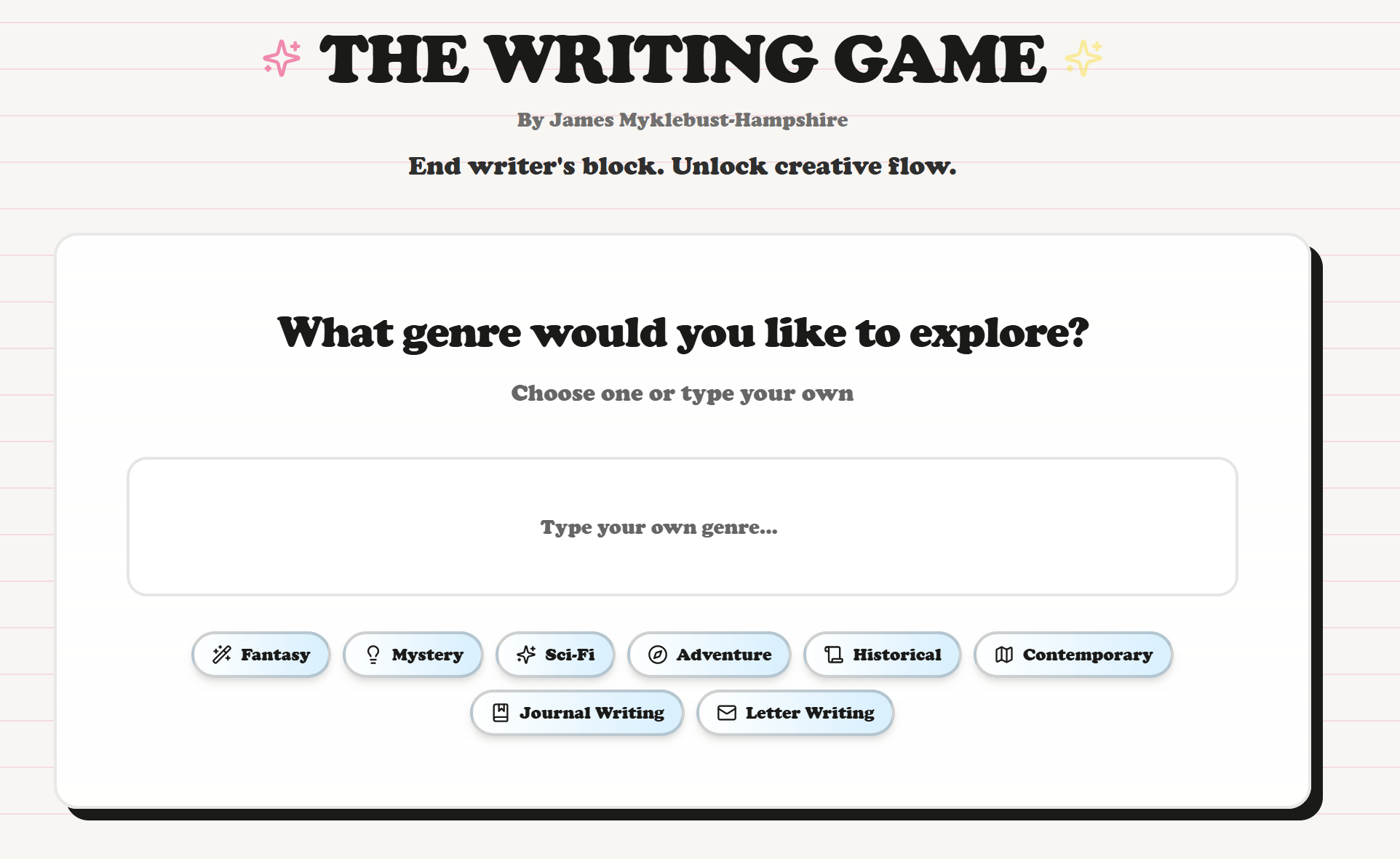
Here’s how the game works…
The Rules
Now, before we dive in, I want to say that the proper writing process requires time and patience. Many students need time to brainstorm, plan, draft, edit, etc. I’m not saying we should scrap this.
What I am saying is that we can use The Writing Game once a week(ish) to unlock student creativity and get a buzz in the room for writing. We want risk-takers, and this is one of the ways to get them.
Rule 1: No erasers. Forget perfection for a minute.
Rule 2: You will not finish (probably). It’s about starting and then continuing.
Rule 3: Mistakes are good. If you don’t know how to spell a word, write it anyway and underline it.
Rule 4: No idea is a bad idea.
Rule 5: Silence during writing rounds.
The Set-up
I didn’t have the luxury of the app I created back when I developed this. All you need to do now is fill in the fields on the setup screen. You’ll share your themes, genres, grade level and student interest, as well as quickly add in a class list (you’ll see why later on).
The Game
The game begins with an image provocation. This is AI-generated based on your input, and will serve as the common starting point for all the stories in the class.
The game then moves through a series of timed rounds, culminating in three students chosen at random to read their unfinished pieces to the class.
The Rounds
The app selects from about 15 pre-programmed rounds and serves them on the screen. Early on, the rounds are “Starter” rounds and include lots of dialogue between students. Pairs and small groups are randomly assigned by the app, using the class list you provided. Each round has a timer, and they vary in length.
The middle rounds are mostly writing rounds. Some are short 3-minute sprints, others are longer bouts. The aim is to build excitement and ideas, then have them furiously write them down before the timer runs out. This gets them moving.
Every now and then, a curveball is thrown in. This could be an AI-generated object or character that the writer must introduce in that section of writing. One curveball is to swap with a random partner, read their piece and then continue it for five minutes. Rounds like these help students detach from their pieces and learn to pivot. They don’t need to be so precious about everything; just write and go with the flow.
We also have some editing rounds, in which students meet up with an editing buddy to look over the underlined spelling words, vocab choice, grammar, etc, and some illustration rounds where they might be asked to quickly design the front cover, or draw one of their settings. They provide a respite from writing and allow for reflection, rest, and the generation of new ideas.
Then what?
Well, if you play this a few times, you’ll begin to notice that students are able to start writing a lot quicker than before. They’ll have more ideas and will be willing to take more risks.
The best part, however, is that each student will now have a book full of ideas they can use to develop more fully as part of a proper writing process. They might have an awesome character over here, a beautifully described setting over there, a few rich vocabulary words scrawled in the margins, and a lovely little plot twist somewhere else.
If you want to be all teacher-y about it, you can also use all their underlined words to generate your spelling lists, while pulling out rich vocabulary to have up on a poster for all to see and use. You can do much more, of course, but I’ll leave that to your imagination.
Let me know how it goes.
James